Acute Kidney Injury
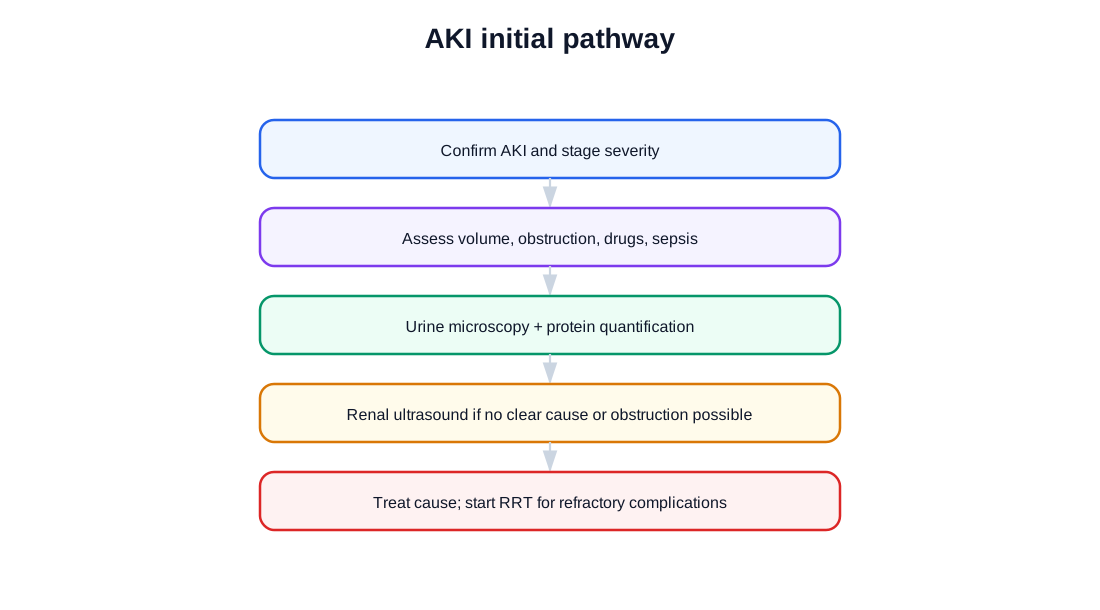
Quick read: Stage the AKI, rule out urgent complications (hyperkalemia, acidosis, pulmonary oedema, obstruction, RPGN/TMA), classify as pre-renal / intrinsic / post-renal, then treat the cause.
Do not miss
Anuria (consider obstruction or cortical necrosis) · RPGN (active sediment + rapid decline, biopsy urgently) · Severe hyperkalaemia (K⁺ >6.5 or ECG changes) · Uraemic pericarditis or encephalopathy · TMA (microangiopathic haemolytic anaemia + thrombocytopenia)
Clinical pearl
FENa <1% suggests pre-renal physiology but is unreliable after diuretics, contrast, myoglobinuria or early obstruction. Use FEUrea <35% instead in these settings.
Practical orientation: Use this page as a triage tool. Identify urgent complications first, then work through the differential systematically.
Use first: clinical summary and algorithm.
Then: differential diagnosis, workup and management tables.
Escalate: use red flags and biopsy / RRT sections.
Clinical summary
Definition
Sudden loss of kidney function — rising creatinine and/or reduced urine output over hours to days.
First step
Stage severity, establish baseline, assess volume status, drugs, sepsis and obstruction.
Do not miss
Anuria, RPGN, TMA, obstruction, severe hyperkalaemia, acidosis, pulmonary oedema, uraemia.
Core tests
BMP, Ca, PO4, albumin, CPK, UA with microscopy, UPCR/UACR, CBC — plus imaging when needed.
Treatment
Supportive care plus cause-specific treatment; RRT for refractory complications.
Algorithm
Staging
| Stage | Creatinine criterion | Urine output criterion |
|---|---|---|
| 1 | Rise ≥0.3 mg/dL within 48 h, or 1.5–1.99× baseline within 7 days | <0.5 mL/kg/h for 6–12 h |
| 2 | 2.0–2.99× baseline | <0.5 mL/kg/h for ≥12 h |
| 3 | ≥3× baseline, creatinine ≥4.0 mg/dL, or need for RRT | <0.3 mL/kg/h for ≥24 h or anuria ≥12 h |
Causes
| Category | Important causes |
|---|---|
| Pre-renal | Hypovolaemia, cirrhosis, shock, cardiorenal physiology, abdominal compartment syndrome, hepatorenal syndrome, hypercalcaemia |
| Intrinsic — glomerular | GN, RPGN, anti-GBM disease, immune-complex GN, ANCA vasculitis |
| Intrinsic — vascular/TMA | TTP/HUS, DIC, complement-mediated or drug-mediated TMA, APS, malignant HTN, scleroderma renal crisis, renal artery/vein occlusion |
| Intrinsic — tubular | ATN from sepsis/ischaemia/toxins, cast nephropathy, crystal nephropathy |
| Intrinsic — interstitial | Drug-induced AIN, infection, SLE, Sjögren, IgG4 disease, sarcoidosis, TINU |
| Post-renal | Stones, BPH/prostate cancer, malignancy, clots, papillary necrosis |
Urine findings
| Finding | Consider |
|---|---|
| Bland sediment or hyaline casts | Pre-renal AKI or obstruction |
| Muddy-brown granular casts / RTE cells | ATN |
| Dysmorphic RBCs or RBC casts | GN or vasculitis |
| WBC casts | AIN, pyelonephritis or GN |
| Crystals | Drug crystals, uric acid, calcium oxalate, phosphate nephropathy |
Pre-renal vs ATN pattern
| Measurement | Pre-renal | ATN |
|---|---|---|
| BUN/Cr ratio | >20:1 | <20:1 |
| Specific gravity | >1.020 | ~1.010 |
| Urine osmolality | >500 mOsm/kg | <350 mOsm/kg |
| Urine sodium | <10–20 mmol/L | >20–40 mmol/L |
| FENa | <1% | >2% |
| FEUrea | <35% | >35% |
Indications for kidney biopsy in AKI
- Unresolving AKI without clear diagnosis after 2–3 weeks
- Suspected GN or RPGN
- Suspected AIN when steroid therapy is under consideration
- Suspected paraprotein-related kidney disease
- Active sediment or nephrotic-range proteinuria with unclear aetiology
Prevention
| Measure | Practical approach |
|---|---|
| Nephrotoxins | Minimise contrast, NSAIDs, aminoglycosides and other toxic drug exposures |
| Haemodynamics | Avoid volume depletion and hypotension, especially perioperatively |
| Dosing | Adjust all medications to current kidney function |
| Fluids | Prefer crystalloids; balanced crystalloids (Hartmann’s / PlasmaLyte) often reasonable |
| Contrast | Use minimal volume of low/iso-osmolar contrast; isotonic fluid pre-/post-procedure if tolerated |
Management
| Step | Action |
|---|---|
| Cause | Treat sepsis, hypovolaemia, obstruction, RPGN, TMA or toxin exposure |
| Complications | Treat hyperkalaemia, acidosis, pulmonary oedema and uraemia promptly |
| Medications | Stop nephrotoxins; dose-adjust renally cleared drugs |
| Diuretics | Use for volume control only — they do not accelerate renal recovery |
| RRT | Start for refractory acidosis, hyperkalaemia, volume overload, uraemic complications or dialysable toxin |
RRT
Prognosis
Recovery depends on injury severity and duration, baseline kidney function and comorbidity burden. Nonoliguric ATN generally carries a better prognosis than oliguric ATN.