Fluid Imbalance
Fluid Imbalance - Clinical framework for dehydration, volume depletion and volume overload.
Practical orientation: Separate tonicity problems from volume problems. Dehydration is not the same as volume depletion.
Use first: clinical summary and algorithm.
Then: differential diagnosis, workup and management tables.
Escalate: use red flags and biopsy/urgent-care sections.
Clinical summary
Dehydration
Loss of total body water causing hypertonicity.|Hypernatremia and cellular dehydration.
Volume depletion
Loss of ECF sodium-containing fluid.|Reduced effective arterial blood volume and tissue hypoperfusion.
Volume overload
Sodium excess and expanded ECF volume.|Edema, pulmonary congestion, hypertension and venous congestion.
Algorithm
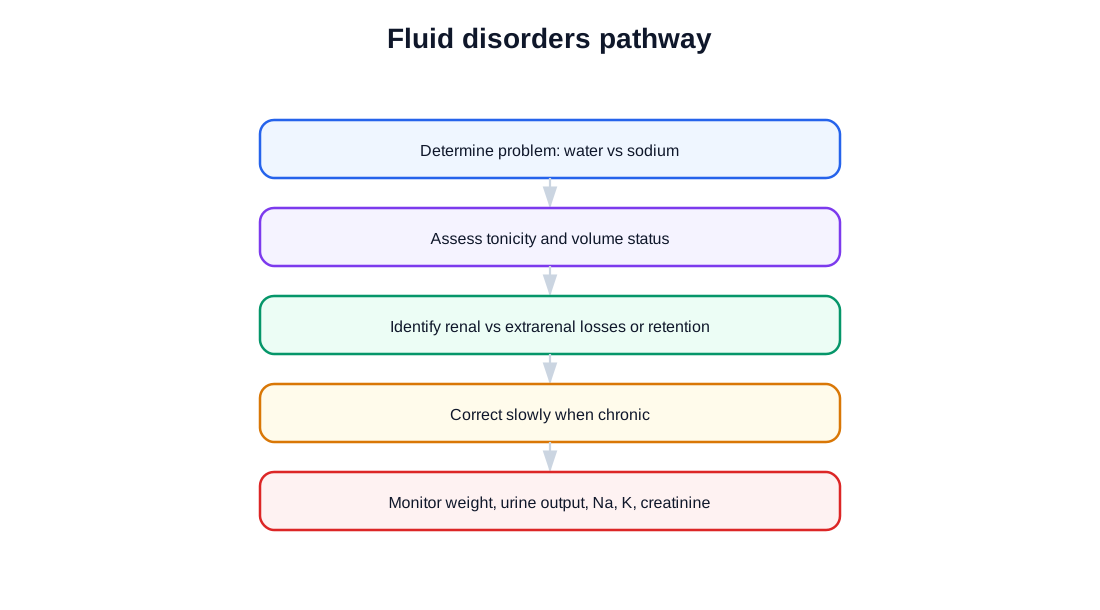
Body fluid compartments
| Compartment | Approximate proportion |
|---|---|
| Total body water | About 60% of ideal body weight in young men; lower in women and older adults. |
| Intracellular fluid | About two-thirds of total body water. |
| Extracellular fluid | About one-third of total body water. |
| Interstitial fluid | About three-quarters of ECF. |
| Intravascular fluid | About one-quarter of ECF. |
Dehydration and hypernatremia
| Concept | Meaning |
|---|---|
| Osmolality | Total solute particles per kg water. |
| Tonicity | Effective osmoles that determine water movement across membranes. |
| Dehydration | Loss of TBW leading to hypertonicity; not the same as volume depletion. |
| Hypernatremia | Usually water deficit rather than sodium excess. |
Hypernatremia by volume status
| Volume status | Salt | Water | Mechanism |
|---|---|---|---|
| Hypovolemic | Low | Very low | Loss of hypotonic fluid. |
| Euvolemic | Neutral | Low | Electrolyte-free water loss. |
| Hypervolemic | High | Neutral/high | Sodium gain, often iatrogenic. |
Correct chronic hypernatremia gradually to avoid cerebral edema.
Volume depletion
| Domain | Practical points |
|---|---|
| Definition | Deficit in ECF volume from loss or sequestration of sodium-containing fluid. |
| Causes | GI losses, diuretics, osmotic diuresis, salt-wasting nephropathies, burns, hemorrhage, pancreatitis, obstruction/peritonitis, crush injury. |
| Findings | Weight loss, thirst, orthostasis, tachycardia, oliguria, delayed capillary refill, low UNa unless confounded. |
| Severe | Hypovolemic shock with cold extremities, cyanosis, altered mentation and organ ischemia. |
Volume overload
| Domain | Practical points |
|---|---|
| Causes | Heart failure, cirrhosis, nephrotic syndrome, CKD/ESRD, sodium retention, medications. |
| Findings | Weight gain, hypertension, JVD, edema, orthopnea, rales, ascites, gut edema and venous congestion. |
| Kidney effect | Renal interstitial edema and renal venous congestion can worsen kidney function. |
| Management | Daily weights and balance, sodium restriction, diuretics, treat underlying disease and use dialysis/UF when needed. |
Fluid imbalance in ESRD
| Concept | Practical approach |
|---|---|
| Dry weight | Lowest tolerated postdialysis weight without signs of hypo- or hypervolemia. Reassess regularly. |
| Overestimated dry weight | Hypertension, pulmonary edema and chronic overload. |
| Underestimated dry weight | Cramps, hypotension and loss of residual kidney function. |
| UF rate | Prefer gradual fluid removal; reduce interdialytic weight gain and extend treatment duration when needed. |
| Residual urine | High-dose loop diuretics may help if meaningful urine output remains. |