Proteinuria
Proteinuria - Clinical approach to detection, classification and management of proteinuria.
Practical orientation: Start by distinguishing albuminuria from non-albumin proteinuria. Discordance between UACR, UPCR and dipstick is often the key diagnostic clue.
Use first: clinical summary and algorithm.
Then: differential diagnosis, workup and management tables.
Escalate: use red flags and biopsy/urgent-care sections.
Clinical summary
Definition
Urine protein excretion >150 mg/day.
Initial tests
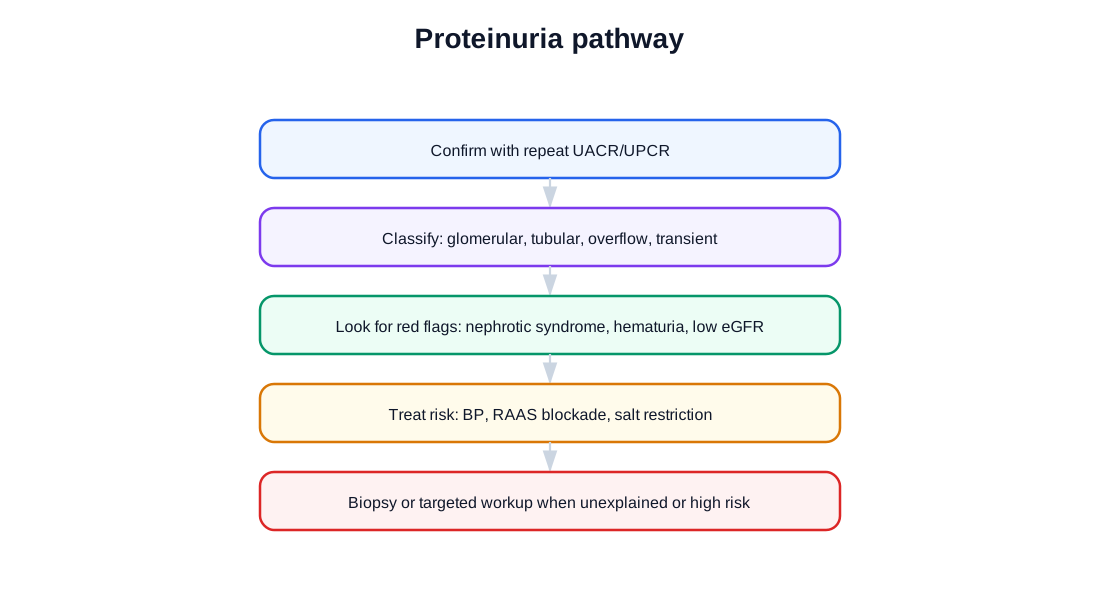
Request both UACR and UPCR. Dipstick alone misses non-albumin proteins.
Main categories
Glomerular, tubular, overflow, transient and orthostatic proteinuria.
Red flags
Nephrotic syndrome, hematuria, falling eGFR, systemic disease, monoclonal protein suspicion.
Initial management
Treat cause; control BP; reduce sodium intake; use ACEi/ARB when appropriate.
Algorithm
Urinary proteins
| Protein | Usual meaning |
|---|---|
| Tamm-Horsfall protein / uromodulin | Produced in the TAL; matrix of many casts; mutations can cause ADTKD. |
| Albumin | Main marker of glomerular filtration barrier injury. |
| Retinol-binding protein, alpha-1 microglobulin, beta-2 microglobulin | Low-molecular-weight proteins; increased urine levels suggest proximal tubular dysfunction. |
| Light chains | Suggest plasma cell dyscrasia or monoclonal gammopathy when discordant with albumin. |
Testing strategy
| Test | Strength | Limitation |
|---|---|---|
| Dipstick | Cheap, rapid, albumin-sensitive. | Insensitive to LMW proteins and light chains; concentration dependent. |
| UPCR | Convenient estimate of total protein. | Diurnal variation; affected by creatinine excretion. |
| UACR | Best for albuminuria and glomerular risk stratification. | Misses non-albumin proteinuria. |
| 24-hour urine protein | Reference method. | Cumbersome and prone to collection error. |
| SSA test | Detects non-albumin proteins including light chains. | False positives with some drugs/contrast. |
Interpreting patterns
| Pattern | Think of |
|---|---|
| UACR and UPCR both high | Glomerular proteinuria. |
| UPCR high with relatively low UACR | Tubular proteinuria or overflow proteinuria, including light chains. |
| Dipstick negative but UPCR high | LMW proteins or paraproteins. |
| Transient proteinuria | Fever, exercise, seizure or cold exposure. |
| Orthostatic proteinuria | Mostly children/adolescents; usually benign. |
Glomerular proteinuria
Albuminuria is the hallmark. A2 albuminuria is 30-300 mg/g; A3 albuminuria is >300 mg/g. Falling proteinuria with stable kidney function usually indicates response or remission in glomerular disease.
| Management domain | Practical approach |
|---|---|
| Sodium | Low sodium intake potentiates antiproteinuric therapy. |
| RAAS blockade | ACEi or ARB if tolerated, especially with albuminuria. |
| BP | Lower targets are often used when significant proteinuria is present, individualized by tolerance. |
| Biopsy | Consider when proteinuria is unexplained, nephrotic range, associated with active sediment, or accompanied by falling eGFR. |
Tubular proteinuria
Tubular proteinuria reflects impaired proximal tubular reabsorption of filtered LMW proteins. It can be missed by dipstick.
| Cause group | Examples |
|---|---|
| Acquired tubular injury | ATN, tubulointerstitial disease, tenofovir, ifosfamide, heavy metals. |
| Light chain proximal tubulopathy | Important acquired cause of Fanconi syndrome. |
| Genetic | Cystinosis, Dent disease, Donnai-Barrow syndrome, Imerslund-Grasbeck disease. |
Overflow proteinuria
Filtered protein load exceeds tubular reabsorptive capacity. Important causes are light-chain cast nephropathy, rhabdomyolysis, hemolysis and lysozyme-induced nephropathy.