Renal Pathology
Renal Pathology - How kidney biopsy tissue is processed and how common glomerular and tubulointerstitial patterns are interpreted.
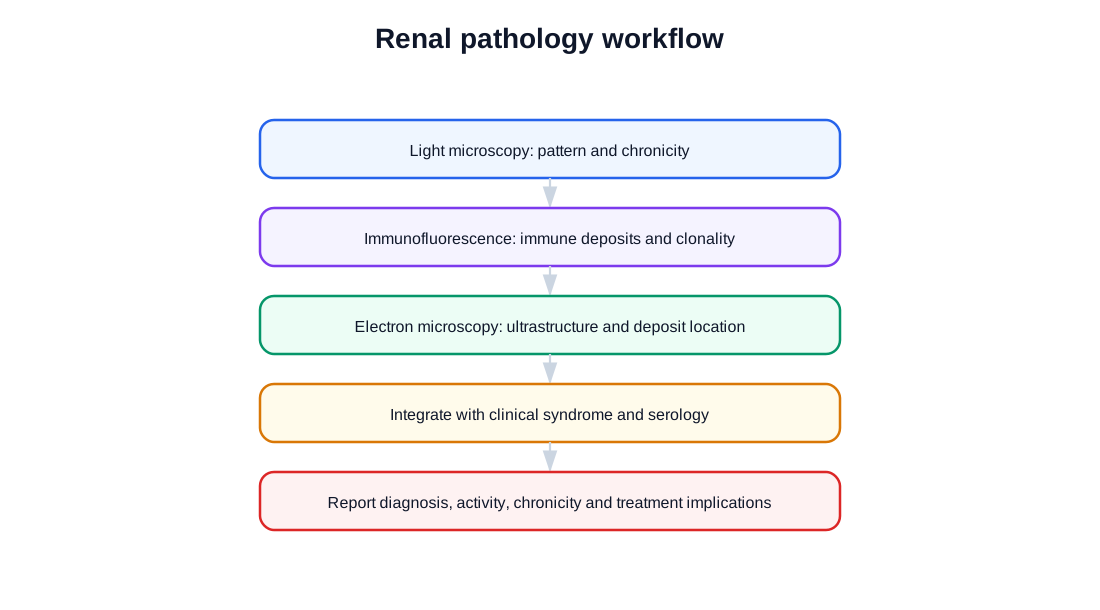
Practical orientation: Integrate LM, IF and EM. No single modality is sufficient for many glomerular diseases.
Use first: clinical summary and algorithm.
Then: differential diagnosis, workup and management tables.
Escalate: use red flags and biopsy/urgent-care sections.
Clinical summary
Light microscopy
Pattern of injury, activity, chronicity and compartment involvement.
Immunofluorescence
Immune deposit type, location, complement, light-chain restriction and C4d.
Electron microscopy
Deposit location/structure, GBM changes, podocyte foot process effacement and ultrastructure.
Algorithm
Tissue processing
| Method | Tissue / stains | Main use |
|---|---|---|
| LM | Formalin-fixed tissue; H&E, PAS, JMS, trichrome. | Morphologic pattern and chronic scarring. |
| IF | Frozen tissue in transport medium; IgG, IgA, IgM, C3, C1q, fibrinogen, kappa/lambda. | Immune phenotype and deposit pattern. |
| EM | Glutaraldehyde-fixed tissue. | Ultrastructural confirmation. |
Terminology
| Term | Meaning |
|---|---|
| Focal | <50% of glomeruli involved. |
| Diffuse | >50% of glomeruli involved. |
| Segmental | Part of a glomerulus involved. |
| Global | Whole glomerulus involved. |
| Mesangial proliferation | Increased mesangial cells/matrix. |
| Endocapillary proliferation | Capillary lumina occluded by leukocytes or swollen endothelial cells. |
| Crescent | Extracapillary proliferation, often with severe active injury. |
Common glomerular patterns
| Pattern | LM / IF / EM clues | Differential |
|---|---|---|
| Mesangial proliferative GN | Mesangial hypercellularity; mesangial deposits. | IgAN, lupus class II, resolving infection-related GN, C3G. |
| Endocapillary proliferative GN | Leukocytes/endothelial swelling; subendothelial +/- mesangial deposits. | Infection-related GN, lupus, cryoglobulinemic GN, PGNMID. |
| MPGN pattern | Hyperlobulated glomeruli, double contours, interposition. | Immune-complex MPGN, C3G, TMA mimics. |
| Crescentic GN | Cellular/fibrocellular/fibrous crescents; necrosis may be present. | Pauci-immune ANCA, anti-GBM, immune-complex GN. |
| FSGS | Segmental sclerosis; variants include collapsing, tip, cellular, perihilar and NOS. | Primary podocytopathy or secondary hyperfiltration/adaptive disease. |
| Membranous nephropathy | Granular capillary wall IgG/C3 with subepithelial deposits and spikes. | Primary PLA2R/THSD7A or secondary autoimmune/infection/malignancy/drugs. |
| TMA | Thrombi, endotheliosis, mesangiolysis, double contours, onion-skinning. | TTP/HUS, malignant HTN, scleroderma, APS, drugs, complement-mediated. |
Organized deposits and dysproteinemia
| Disease | Clue |
|---|---|
| Cryoglobulinemic GN | MPGN/DPGN, intracapillary immune thrombi, annular-tubular deposits. |
| Immunotactoid GN | Parallel microtubules; often monoclonal IgG. |
| Fibrillary GN | Random fibrils, Congo red negative, DNAJB9 positive. |
| Light chain cast nephropathy | Hard fractured casts with light-chain restriction. |
| Light chain proximal tubulopathy | Proximal tubular crystals, often kappa restricted. |
| MIDD | Linear staining of renal basement membranes, granular deposits. |
| AL amyloidosis | Congo red positive fibrils, usually lambda more than kappa. |
| PGNMID | Monoclonal IgG subclass and light chain with proliferative GN. |
Tubulointerstitial patterns
| Pattern | Clues |
|---|---|
| ATN | Tubular simplification, loss of brush border, casts, vacuolization. |
| AIN | Interstitial inflammation/edema and tubulitis; eosinophils suggest drug allergy. |
| IgG4-related TIN | Plasma cell-rich infiltrate, storiform fibrosis, IgG4-positive plasma cells. |
| Pyelonephritis | Neutrophilic tubulitis and neutrophil casts. |
Transplant pathology basics
| Pattern | Key concept |
|---|---|
| T-cell mediated rejection | Tubulitis, interstitial inflammation and/or intimal arteritis. |
| Antibody-mediated rejection | Tissue injury + antibody-endothelium interaction + donor-specific antibodies. |
| Chronic active rejection | Chronic tissue injury with ongoing immune activity. |